

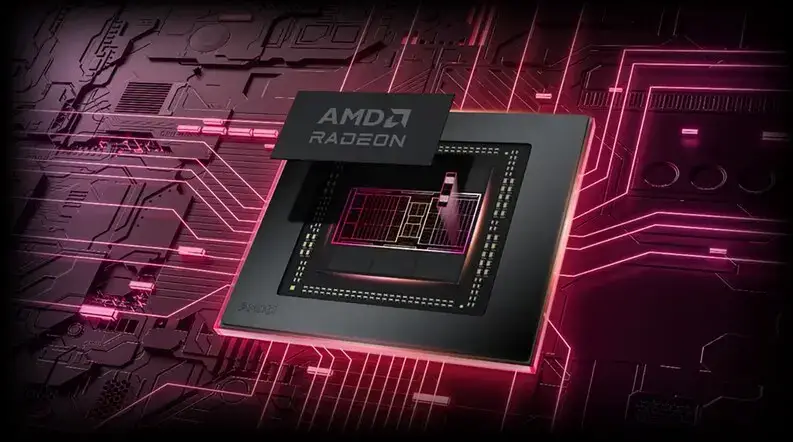
AMD is preparing to launch its most ambitious GPU architecture yet—RDNA 5, also known internally as UDNA (Unified Data and Neural Architecture). Slated for release in mid to late 2026, RDNA 5 aims to redefine performance, efficiency, and AI integration across gaming, professional workloads, and next-gen consoles.
This architecture will succeed RDNA 4 and power the upcoming Radeon RX 10000 series, bringing with it a host of innovations that position AMD to challenge Nvidia’s Blackwell GPUs head-on.
RDNA 5 Architecture Highlights
- Process Node: TSMC 3nm
- Compute Units: Up to 96 CUs in flagship models
- Memory Interface: 384-bit with GDDR7 support
- Infinity Cache: Up to 192MB, optimized for ray tracing and AI workloads
- AI Acceleration: Dedicated neural arrays for real-time upscaling, frame generation, and radiance caching
- Ray Tracing: Hardware-level ray regeneration and denoising pipelines
- Chiplet Design: Modular GPU tiles for compute, cache, and graphics—improving scalability and yields
- Power Efficiency: Enhanced dynamic voltage scaling and clock gating for better perf-per-watt
Performance Expectations
Early internal benchmarks and leaks suggest RDNA 5 could deliver:
- 30–40% raster performance uplift over RX 7900 XTX
- 2× ray tracing throughput via redesigned RT cores
- Up to 3× AI inference speed compared to RDNA 3, rivaling Nvidia’s Tensor cores
- Significant latency reduction in frame generation and upscaling pipelines
These gains are expected to be most visible in titles optimized for FSR 5, DirectX 12 Ultimate, and AFMF 2.0, especially when paired with AMD’s upcoming Ryzen 9000 CPUs.
Strategic Positioning
RDNA 5 is AMD’s answer to Nvidia’s RTX 60 series and Intel’s Xe3 Celestial architecture. With a focus on AI-first rendering, modular scalability, and console-ready efficiency, RDNA 5 will likely power:
- Radeon RX 10000 GPUs
- Next-gen APUs (Strix Halo refresh)
- Future PlayStation and Xbox consoles
- AI-enhanced cloud gaming platforms